Ići is always moving—not only through streets and cities, but through every person of the Serbian present tense.
Present Tense of to Go
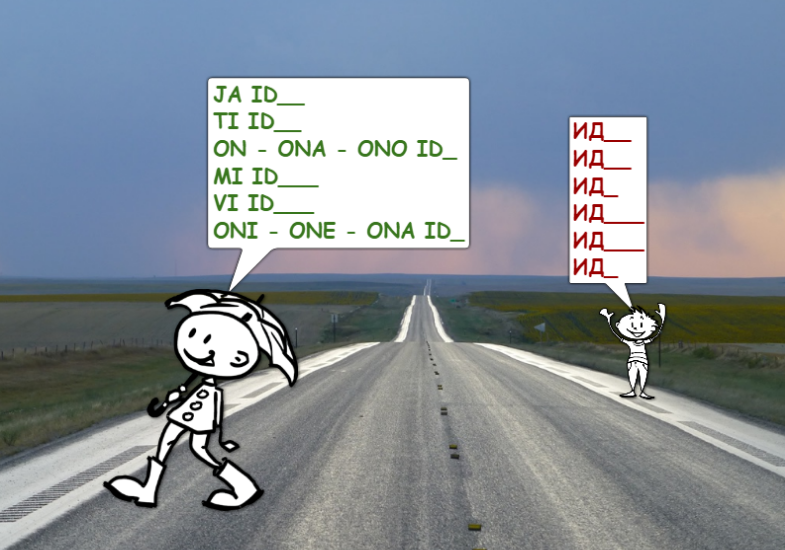
- Ja idem - ti ideš - on/ona/ono ide ///// mi idemo - vi idete - oni / one / ona idu
Common Serbian Phrases with this Verb
- Gde ideš? = Where are you going?
- Kada ideš u školu? = When are you going to school?
- Gde ideš u kupovinu/prodavnicu? = Where are you going shopping?
- Zašto ideš na posao tako kasno? = Why are you going to work so late?
- Gde ideš na odmor svake godine? = Where do you go on holiday every year?
- Kad idete na odmor? = When are you going on holiday?
- Ko ide u školu? = Who is going to school?
- Ko ide sa mnom? = Who is going with me?
- Ko ide ka Beogradu? = Who is going to (towards) Belgrade?
- Kada ideš u Beograd sa mamom? = When are you going to Belgrade with me?
Your task
From the ići table to real sentences
Recognising the answer in Verb Conjugations in Serbian - Present Tense of Go is only the first stage. The goal is to recall it quickly, pronounce it clearly and adjust it for a different person, place or time. Use the new examples as stepping stones.
Cover a person and rebuild the form
Read down the Latin column, then switch to Cyrillic without returning to English. Choose two examples, turn one into a question and make the other negative. Say both versions naturally. For this post, keep your final version connected with the situation in Verb Conjugations in Serbian - Present Tense of Go.
ići and its irregular stem
Serbian present-tense verbs change for person and number. Find the stem, notice the ending set, and practise affirmative, negative and question forms in situations you might genuinely describe. In this particular lesson, use that principle to interpret the examples connected with Verb Conjugations in Serbian - Present Tense of Go.
Compare ići with a regular verb
| Latin script | Cyrillic script | English |
|---|---|---|
| Idem na pijacu svake subote. | Идем на пијацу сваке суботе. | I go to the market every Saturday. |
| Ideš li sa nama na izlet? | Идеш ли са нама на излет? | Are you coming with us on the trip? |
| Ide pravo pa skreće levo. | Иде право па скреће лево. | He goes straight on and then turns left. |
| Idemo peške, nije daleko. | Идемо пешке, није далеко. | We are walking, it is not far. |
| Idu na more krajem jula. | Иду на море крајем јула. | They are going to the seaside at the end of July. |
Choose one row and copy it in both scripts without looking back. When you check it, correct letters and diacritics first; only afterwards consider speed. Apply that script strategy to the vocabulary in Verb Conjugations in Serbian - Present Tense of Go.
Check your Serbian: Verb Conjugations in Serbian - Present Tense of Go
Finish with five short translations. Keep the vocabulary and grammatical relationship from this lesson consistent in both Serbian scripts. Keep every answer connected with Verb Conjugations in Serbian - Present Tense of Go.
- I live in Serbia.
- You go to work by bus.
- She works in a small school.
- We have a lesson at five.
- They drink coffee every morning.
Answers for the present tense of ići
- Ja živim u Srbiji.
Ја живим у Србији. - Ti ideš na posao autobusom.
Ти идеш на посао аутобусом. - Ona radi u maloj školi.
Она ради у малој школи. - Mi imamo čas u pet.
Ми имамо час у пет. - Oni svakog jutra piju kafu.
Они сваког јутра пију кафу.