Morning coffee, work, lunch and evening rest create a familiar rhythm in which Serbian present-tense verbs feel at home.
Daily Routines in Serbian
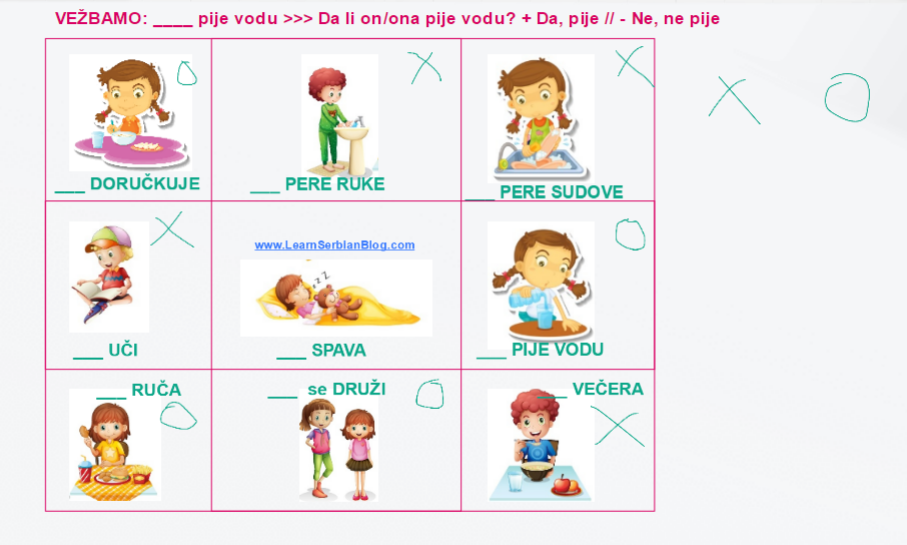
1. PRATI RUKE = to wash hands2. PRATI SUDOVE = to wash the dishes
3. SPAVATI = to sleep
4. UČITI = to learn
5. DRUŽITE SE = to hang out (with friends)
6. DORUČKOVATI = to have breakfast
7. RUČATI = to have lunch
8. VEČERATI = to have dinner
9. PITI VODU = to drink water
For the video lesson, check out my Patreon blog. Thanks for learning with my lessons :D HVALA! .
Let's Practice DAily Routines with Quizlet
Five sentences about an ordinary day
| Latin script | Cyrillic script | English |
|---|---|---|
| Ustajem u pola sedam. | Устајем у пола седам. | I get up at half past six. |
| Perem zube i tuširam se. | Перем зубе и туширам се. | I brush my teeth and take a shower. |
| Doručkujem uz vesti na radiju. | Доручкујем уз вести на радију. | I have breakfast with the news on the radio. |
| Popodne spremam ručak za sutra. | Поподне спремам ручак за сутра. | In the afternoon I prepare lunch for tomorrow. |
| Pred spavanje čitam nekoliko strana. | Пред спавање читам неколико страна. | Before sleeping I read a few pages. |
Listen for the order of the day
Treat Daily Routines in Serbian as spoken language before analysing it on the page. Read or play the original once for the main message, return for the key forms, and finish by producing one sentence without looking.
Everyday verbs in the present tense
Serbian present-tense verbs change for person and number. Find the stem, notice the ending set, and practise affirmative, negative and question forms in situations you might genuinely describe. In this particular lesson, use that principle to interpret the examples connected with Daily Routines in Serbian.
Describe your own morning
Select the sentence closest to your life and make it true for you. Add a reason or time expression, ask another person a related question, and answer it without reading. For this post, keep your final version connected with the situation in Daily Routines in Serbian.
Alternate scripts from row to row instead of treating Cyrillic as an optional extra. The aim is one Serbian sentence, one pronunciation and two equally readable written forms. Apply that script strategy to the vocabulary in Daily Routines in Serbian.
Check your Serbian: Daily Routines in Serbian
Reconstruct these examples from the English prompts. Mark any corrected ending or letter when you compare your Latin and Cyrillic answers with the key. Keep every answer connected with Daily Routines in Serbian.
- I am not going into town today.
- Do you work on Saturdays?
- In the evening we read and listen to music.
- My brother lives near the river.
- The students understand the question well.
Answers for the daily routines
- Ne idem danas u grad.
Не идем данас у град. - Da li radiš subotom?
Да ли радиш суботом? - Uveče čitamo i slušamo muziku.
Увече читамо и слушамо музику. - Moj brat živi blizu reke.
Мој брат живи близу реке. - Učenici dobro razumeju pitanje.
Ученици добро разумеју питање.