Ability becomes conversation when mogu meets a real action, a limitation or a polite question.
In the one of the previous lessons we practiced the verb CAN in the Present Tense in Serbian. Let's revise it once again: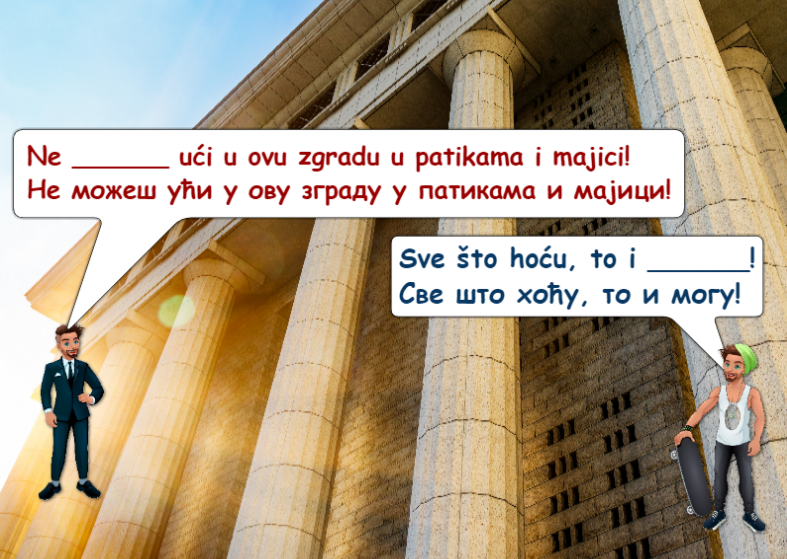
p.s. The response you can see here is from the famous song by Zdravko Čolić. If you like the song, let's learn how to sing it together :)
Asking for and offering help with moći
The central idea in Modal Verbs in Serbian - Can 2 becomes memorable when it is attached to a situation. Imagine who is speaking, where the exchange happens and what response follows. The table below gives you models that can be adapted immediately.
moći, hteti, morati side by side
| Latin script | Cyrillic script | English |
|---|---|---|
| Moram da završim ovo do petka. | Морам да завршим ово до петка. | I have to finish this by Friday. |
| Da li smem da otvorim prozor? | Да ли смем да отворим прозор? | May I open the window? |
| Moramo da završimo vežbu. | Морамо да завршимо вежбу. | We must finish the exercise. |
| Ne moraš da žuriš, imamo vremena. | Не мораш да журиш, имамо времена. | You do not have to hurry, we have time. |
| Trebalo bi da se odmoriš. | Требало би да се одмориш. | You should get some rest. |
Modal verbs and the da construction
After a Serbian modal verb, speakers commonly use da plus the present tense. The subject remains the same across both verbs, while negation normally attaches to the modal: ne mogu da dođem. Practise the whole frame as one reusable unit. In this particular lesson, use that principle to interpret the examples connected with Modal Verbs in Serbian - Can 2.
Every row lets you verify spelling twice. Pay special attention to Latin digraphs and diacritics before reading the Cyrillic form aloud at the same natural pace. Apply that script strategy to the vocabulary in Modal Verbs in Serbian - Can 2.
Ask each question from the table aloud
Read down the Latin column, then switch to Cyrillic without returning to English. Choose two examples, turn one into a question and make the other negative. Say both versions naturally. For this post, keep your final version connected with the situation in Modal Verbs in Serbian - Can 2.
Check your Serbian: Modal Verbs in Serbian - Can 2
Use the English cues to rebuild the Serbian sentences in Latin and Cyrillic. Accuracy of endings and diacritics matters more than speed. Keep every answer connected with Modal Verbs in Serbian - Can 2.
- Do you want to have coffee?
- I want to learn Cyrillic.
- We must finish the exercise.
- Can you repeat the question?
- She does not want to wait for the bus.
Answers for the modal verbs
- Hoćeš li da popiješ kafu?
Хоћеш ли да попијеш кафу? - Želim da naučim ćirilicu.
Желим да научим ћирилицу. - Moramo da završimo vežbu.
Морамо да завршимо вежбу. - Možete li da ponovite pitanje?
Можете ли да поновите питање? - Ona neće da čeka autobus.
Она неће да чека аутобус.