Expand Serbian vocabulary for money, banking, spending, saving, borrowing and earning through useful aspect pairs and realistic situations.
Expanding Serbian Vocabulary - Money Matters
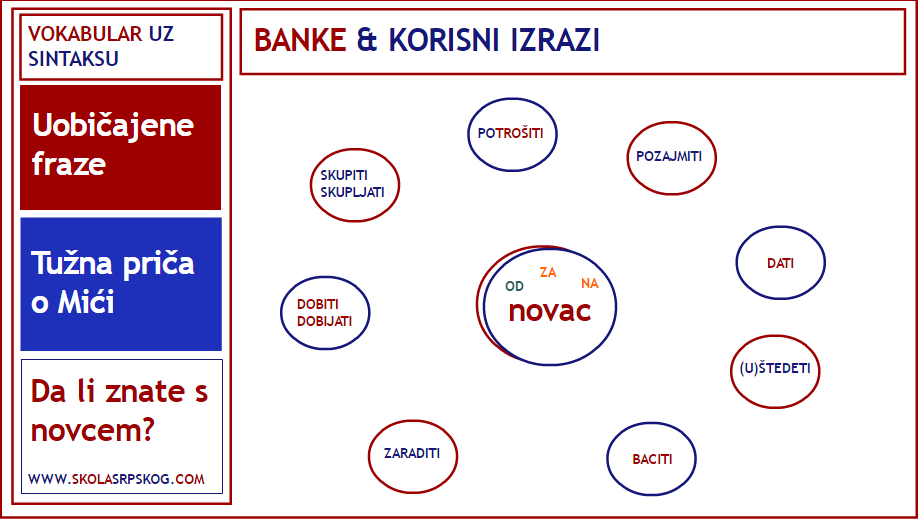
- Trošiti novac (imperfective) // potrošiti (perfective) = to spend (money)
- Dobijati (imp) // dobiti (perf) = to get
- Skupljati (imp) // skupiti (perf) = to collect
- Bacati (imp) // baciti (perf)= to throw
- Štedeti (imp) // uštedeti (perf)= to save (money)
- Davati (imp)// dati (perf) = to give
- Pozajmljivati (imp) // pozajmiti (perf)= to borrow/lend
- Zarađivati (imp) // zaraditi (perf) = to earn
Rešenje i prevod:
Mića troši puno novca iako malo zarađuje. Juče je na primer potrošio deset hiljada u kafani! Najgore od svega je što on uopšte nije zardio taj novac već ga je pozajmio od svog kuma Todora, koji je vrlo štedljiv. Sve što zaradi Todor štedi u srpskim bankama i juče je konačno podigao novac koji je štedeo tri godine. Međutim, baš tad se pojavio Mića na vratima i tražio malu pozajmicu. Todor nije imao srca da mu kaže ne i tako je dao Mići pare. Kao što već znate, Mića je isto veče sve te pare potrošio. Bacio ih je na piće u lokalnoj kafani.
Prevod na engleski:
Mića spends a lot of money, although he earns little. Yesterday, for example, he spent ten thousand dinars in a cafe! The worst of all is that he hasn't earned the money at all, but he borrowed it from his best man, Todor, who is very thrifty. All that he earns, Todor saves in Serbian banks and yesterday he finally withdrew money which he had been saving for three years. However, at the very moment, Mića showed up at the door and asked for a loan. Todor was too weak to say no to him and so he gave the money to Mića. As you already know it, Mića spent it all the same night. He squandered it on drinks in the local cafe.
Talking about money without sounding like a textbook
Money verbs often come in imperfective–perfective pairs. Use the imperfective for habits, repeated actions and processes, and the perfective for a completed transaction or achieved result. Context clarifies ambiguous verbs such as pozajmiti, which can mean to borrow or lend; add od nekoga or nekome when needed. Practise amounts with the correct noun forms as complete phrases.
Money vocabulary is full of verbs that come in aspect pairs — štedeti and uštedeti, trošiti and potrošiti, pozajmljivati and pozajmiti. The choice tells your listener whether you are describing a habit or a completed transaction, which in this topic is usually the whole point of the sentence.
Money sentences in Latin and Cyrillic
| Latin script | Cyrillic script | English |
|---|---|---|
| Svakog meseca štedim deo plate. | Сваког месеца штедим део плате. | Every month I save part of my salary. |
| Juče sam potrošila previše novca. | Јуче сам потрошила превише новца. | Yesterday I spent too much money. |
| Pozajmio sam novac od prijatelja. | Позајмио сам новац од пријатеља. | I borrowed money from a friend. |
| Banka mi je odobrila kredit. | Банка ми је одобрила кредит. | The bank approved my loan. |
| Koliko zarađuješ mesečno? | Колико зарађујеш месечно? | How much do you earn per month? |
Notice the time expressions doing the work: svakog meseca pulls the imperfective, juče pulls the perfective. That pairing is reliable enough to lean on. Read the second column as well, since bank documents and price lists in Serbia frequently appear in Cyrillic.
Describing your own spending
Say three sentences about what you do with money regularly, then three about what you did last week. Then combine them: a habit and an exception. Aspect becomes intuitive when it is attached to your own timeline rather than to an abstract rule about completion.
Money exercise
Translate these sentences into Serbian in both scripts, marking each verb as perfective or imperfective.
- Every month I save part of my salary.
- Yesterday I spent too much money.
- I borrowed money from a friend.
- The bank approved my loan.
- How much do you earn per month?
Answers
- Svakog meseca štedim deo plate.
Сваког месеца штедим део плате. - Juče sam potrošila previše novca.
Јуче сам потрошила превише новца. - Pozajmio sam novac od prijatelja.
Позајмио сам новац од пријатеља. - Banka mi je odobrila kredit.
Банка ми је одобрила кредит. - Koliko zarađuješ mesečno?
Колико зарађујеш месечно?