Learn Serbian

Learning Serbian with exercises, video lessons and online courses

Google Tag Head

Thursday, August 29, 2013

Idioms and Common Phrases in Serbian

After publishing yesterday's post it struck me that you might not  be aware of the  meaning of the phrase "ravno mi je sve".That's why I chose the word RAVAN = flat / even / equal as the topic of today's post:


  • nekome je sve ravno ( do Kosova )= it's all the same ; it makes no difference
example: Uradi kako ti je drago - meni je sve ravno (do Kosova) ! 
translation: Do as you please - it makes no difference to me !

example from the song: Ravno mi je sve : because of the word "mi" this phrase means that he is indifferent, while the sentence before he means literally "ravno, nigde brda" = flat, no hill around 
  • ravan kao dlan = as flat as a pancake 
example: Vojvodina je ravna kao dlan. (Vojvodina is as flat as a pancake.)
  • na ravnoj nozi = on an equal footing; on equal terms
example: Razgovarali smo o svemu na ravnoj nozi (We talked about everything on equal terms)
  • na ravne časti = share and share alike; even Stephen 
example: Sve što zaradimo delimo na ravne časti (Everything we earn we share and share alike)
  • nema mu ravna = without a peer; second to none
example: Kao lekaru nema mu ravna (As a doctor he is second to none.) 

Wednesday, August 28, 2013

Word Order with "se" in Serbian

Here comes a gentle introduction to the fourth part of the series of blog posts about the word order in Serbian. Why introduction in the middle of the story ? Because I'm about to write about the verbs with (reflexive) -se: "vratiti se " = "to come back", for example.

Listen to this beautiful song and try to figure out which word is missing in the following lines:


Od Banata prema Sremu nisko oblaci,
noć __ spustila, pa ___ ne vidi...
samo moje misli po ravnici putuju -
ja ih pošaljem al ___ vraćaju...
A ti, a ti ___ nećeš vratiti....
To je bilo davno, pa ___  niko ne seća -
rode nestale jednog proleća...
vratiće __ , kažu ljudi, ove godine...
ove godine il dogodine...
A ti, a ti ___ nećeš vratiti....

REFREN:
Ravno, nigde brda, sve je ravno - ravno mi je sve,
jer u tvome srcu već odavno drugi stanuje...
Ej,kad bi znala ti...(kad bi samo znala ti)
koliko trebaš mi!

Hajde noći tiho, tiše, sitni tonovi,
da ____  nikome to ne ponovi...
bruje zice, srce trne, grom te pogodi-
to ___  dogodi il ne (__) dogodi....
A ti na belom perju zaspi mi...

REFREN

Tuesday, August 27, 2013

Studying Serbian with Songs

Monday, August 26, 2013

Talking about Yourself in Serbian

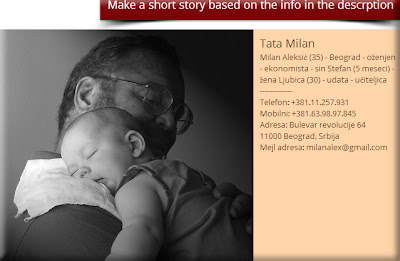
In the previous post with easy Serbian texts, you were able to learn a few facts about Branko and his family.

Today's exercise is from the same Serbian 101 course, but this time your job is to look at the photo with some facts about Milan, and then make a short story and tell it along with this video:

Sunday, August 25, 2013

Accidents and Emergencies - Vocabulary and Phrases in Serbian

I've recently received a very practical question : how to call for help in Serbian and  what to say in case of  an accident / theft and similar. So, let me give you a few ideas for three different topics, which hopefully you won't need at all:

  • Policija / milicija (police)
  1. Policajac (police officer)
  2. Advokat (lawyer)
  3. Prestup (violation)
  4. Prekršaj (offence)
  5. Zovite policiju ! (call the police)
  • Prolbemi
  1. Novčanik (wallet)
  2. Lopov (thief)
  3. Provalnik (burglar)
  4. Izgubljene stvari (lost property)
  5. Ukrasti (to steal)
  6. Izgubiti (to lose)
  7. Zaboraviti (to forget)
  8. Zaboravio sam ključ (I forgot my key)
  9. Izgubio sam ključ (I lost my key)
  10. Neko mi je ukrao pare / novac (Somebody stole my money)
  11. Upomoć ! (Help)
  • Nesrećan slučaj (accident)
  1. Kvar (breakdown)
  2. Služba za hitnu popravku (emergency breakdown service)
  3. Sudar (accident, collision)
  4. Osiguranje (insurance)
  5. Automobil mi se pokvario (my car has broken down)
  6. Vaše osiguranje (Your insurance documents)
  7. Prijaviti sudar (to report an accident)
  8. To je vaša krivica (it's your fault )

Wednesday, August 21, 2013

Beginner Serbian - New Lesson with Exercises


In the previous post about easy texts in Serbian, I said that I wasn't very happy with the quality of the audio recording. Today, when I tried to fix it, I ended up changing the video structure and creating 3 more videos for you to practise. I'm sure you'll like this new version more and that the previous one. If you are a real beginner in Serbian, you can take a look at the vocabulary list while watching the video:


  1. OVO = THIS
  1. JE = IS
  1. OVO JE = THIS IS...
  1. BRAT = BROTHER
  1. SESTRA = SISTER
  1. MUŽ = HUSBAND
  1. ŽENA = WIFE
  1. LEP = BEAUTIFUL (Fem: lepa)
  1. MLAD = YOUNG (Fem: mlada)
  1. RUŽAN = UGLY (Fem: ružna)
  1. STAR = OLD (Fem: stara)
  1. VISOK = TALL (Fem: visoka)
  1. NIZAK = SHORT (Fem: niska)
  1. IMATI = TO HAVE
  1. GODINA = YEARS
  1. DETE = CHILD, DECA  = CHILDREN
  1. BLIZANCI  = TWINS
  1. JOŠ = STILL
  1. MALI = YOUNG / LITTLE / SMALL
  1. PAS = DOG
*** POSSESSIVE ADJECTIVES ***
  • MOJ -mojA sestrA - mojE detE - mojI prijateljI - mojE prijateljicE - mojA decA
  • TVOJ
  • NJEGOV
  • NJEN
  • NJEGOV
  • NJIHOV
  • NJIHOV
  • NJIHOV


Exercise 1 - Verbs are missing. You can mute the video in order to do the exercise on your own.

Exercise 2 - Make a similar story about your family.

Tuesday, August 20, 2013

Word Order in Serbian - Future Tense

This is the third part of the series of  blog posts about the word order or  "red reči" in a Serbian sentence. I covered the word order in the present tense and past tense and today's topic is the future tense. If you find the letter  N next to the sentence, it means that it is the most neutral / natural sounding sentence:


One word verb: pevati (to sing)

Future tense of PEVATI (to sing):   "I'll sing."

Subject (S) + predicate (P)

  • Pevaću. N
  • Ja ću pevati
  • Ti ćeš igrati, a ja ću pevati. N 
  • Sedećeš i slušaćeš, a ja ću pevati. N 
  • Prijatelji su čuli kako ću pevati na koncertu. N 
  • Priznajem da ću  pevati na koncertu. N

S + P +  direct object (dO)
  • Pevaću pesmu. N
  • Ja ću pevati  pesmu.
  • Čuće oni kako ću im otpevati  pesmu.  N (im= njima= to them, indirect object)
  • Svi su čuli da ću  pevati tu pesmu. N

S  + P + dO + adverb of time (AoT)

  • Pevaću pesme svaki dan. N
  • Svaki dan ću pevati pesmu. N
  • Moji prijatelji su pitali kada ću pevati pesmu sledeći put. N

S + P + dO + AoT + AoP (adverb of place)
  • Pevaću  pesmu svaki dan  kod kuće.  N
  • Pevaću pesmu kod kuće svaki dan. n
  • Svaki dan ću pevati pesmu kod kuće. N
  • Kod kuće svaki dan ću pevati pesmu. 
  • Moje komšije će sutra čuti zašto ću kod kuće pevati pesmu. N
  • Moje komšije će čuti zašto ću  pevati pesmu za nedelju dana kod kuće. N
  • Moje komšije će igrati uz iks-boks dok ću ja pevati pesme uz xbox kod kuće za nedelju dana. N

Advanced Serbian - Srpski kao drugi jezik

Gde je ključ? Где је кључ? - Učimo srpski sa Marinom
Gde je ključ? ...
Where is the Key?-...
By Marina Petrović
Photo book