Listen internally to “Opština je izdvojila sredstva za novi vrtić.” and imagine a natural reply. Move to “Kupac snosi dodatne troškove dostave.” only when the first exchange can be produced without reading.
Common Money Collocations in Serbian
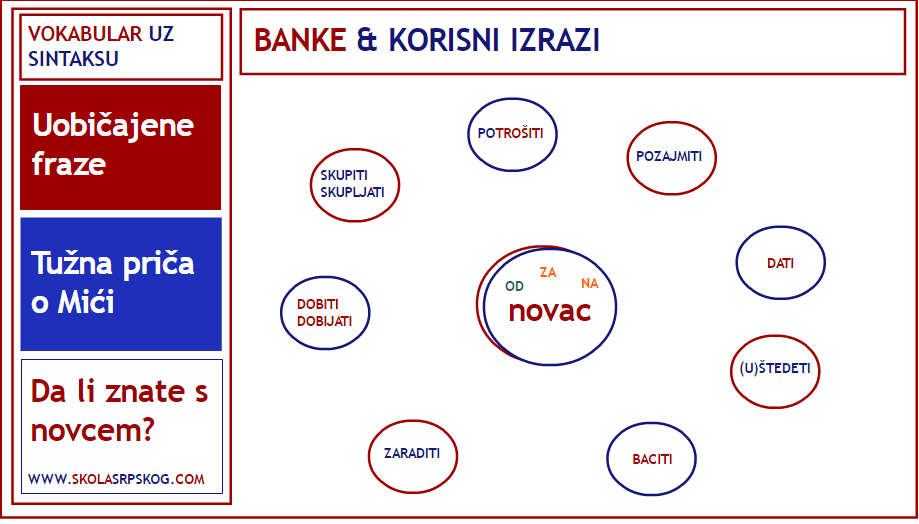
In this lesson we are expanding our vocabulary by learning the collocations about money. Let me list the verbs in both imperfective and perfective aspect, which commonly collocate with the word money (novac or pare)- Trošiti - potrošiti novac: to spend money
- Pozajmljivati - pozajmiti novac: to borrow/lend money
- Davati - dati novac: to give money
- Štedeti - uštedeti novac: to save money
- Bacati - baciti novac: to throw money away
- Zarađivati - zaraditi novac: to earn money
- Dobijati - dobiti novac: to get money
- Skupljati - skupiti novac: to raise money
Practicing Money Collocations in Serbian
For more video lessons and exercises, check out my Patreon page. Thanks for supporting me!
Five Financial Partnerships Worth Keeping
Serbian financial language relies on stable partnerships: sredstva se izdvajaju, troškovi se snose, dug se izmiruje and cena raste. Memorise the noun together with its usual verb so formal sentences sound natural.
Finish with “Kurs dinara ostao je stabilan tokom meseca.” and “Porodica pažljivo raspoređuje kućni budžet.”. One should become a short dialogue; the other should be recorded twice, with clearer rhythm and more confident recall on the second attempt.
Money Moves through Serbian Collocations
Which context makes “Opština je izdvojila sredstva za novi vrtić.” natural? Compare it with “Kupac snosi dodatne troškove dostave.”, then give “Preduzeće je izmirilo dug prema dobavljačima.” a different speaker and purpose.
Troškovi Rastu, Dug Se Izmiruje
| Latin script | Cyrillic script | English |
|---|---|---|
| Opština je izdvojila sredstva za novi vrtić. | Општина је издвојила средства за нови вртић. | The municipality allocated funds for a new nursery. |
| Kupac snosi dodatne troškove dostave. | Купац сноси додатне трошкове доставе. | The buyer bears the additional delivery costs. |
| Preduzeće je izmirilo dug prema dobavljačima. | Предузеће је измирило дуг према добављачима. | The company settled its debt to suppliers. |
| Kurs dinara ostao je stabilan tokom meseca. | Курс динара остао је стабилан током месеца. | The dinar exchange rate remained stable during the month. |
| Porodica pažljivo raspoređuje kućni budžet. | Породица пажљиво распоређује кућни буџет. | The family carefully allocates the household budget. |
Choose the Verb a Financial Noun Expects
Translate all five meanings without copying. Use “Kurs dinara ostao je stabilan tokom meseca.” only as a final reference point, and supply both Serbian scripts before checking the complete answers.
- The municipality allocated funds for a new nursery.
- The buyer bears the additional delivery costs.
- The company settled its debt to suppliers.
- The dinar exchange rate remained stable during the month.
- The family carefully allocates the household budget.
Answers and both Serbian scripts
- Opština je izdvojila sredstva za novi vrtić.
Општина је издвојила средства за нови вртић. - Kupac snosi dodatne troškove dostave.
Купац сноси додатне трошкове доставе. - Preduzeće je izmirilo dug prema dobavljačima.
Предузеће је измирило дуг према добављачима. - Kurs dinara ostao je stabilan tokom meseca.
Курс динара остао је стабилан током месеца. - Porodica pažljivo raspoređuje kućni budžet.
Породица пажљиво распоређује кућни буџет.